Products

I Tried 12 Datanyze Alternatives. These Are the Ones I’d Actually Use.

Datanyze helped popularize technographic prospecting long before “sales intelligence” became a crowded category. For many SDRs, it was the first tool that made it easy to identify the technologies a company used and turn that information into better outreach.

The market has changed considerably since then.

Today, sales teams expect much more than a Chrome extension that identifies a website’s tech stack. They want bulk prospecting, downloadable lead lists, APIs, CRM integrations, historical technology adoption, and coverage that extends well beyond a few thousand popular technologies.

To see how Datanyze compares today, I spent time testing it alongside several established competitors and newer platforms. Some focused on technographics, others approached the problem through broader sales intelligence. A few surprised me.

Here’s what I’d actually recommend.

Why People Start Looking for Datanyze Alternatives

Most people aren’t replacing Datanyze because it’s a bad product. They’re replacing it because their workflow has outgrown it.

A freelancer researching a handful of websites each day has very different requirements than a revenue operations team qualifying thousands of accounts every week.

These are the most common reasons I found people switching.

They need broader technology coverage

Modern companies use hundreds of SaaS products across marketing, engineering, analytics, customer support, payments, infrastructure, and security.

A limited technology database inevitably misses part of that stack, which means missing valuable buying signals.

For example, knowing that a prospect uses Shopify is useful. Knowing they also use Klaviyo, Recharge, Gorgias, Postscript, Nosto, Segment, and Snowflake paints a much clearer picture of their business and the tools they’re likely to adopt next.

They want prospecting, not just research

Identifying technologies on one website is helpful.

Building a list of 8,000 companies using HubSpot, Stripe, Cloudflare, and Vercel is considerably more valuable for outbound sales.

Many newer platforms have shifted their focus toward technology-based lead generation rather than individual website lookups.

Freshness matters

Technology stacks change constantly.

Companies migrate from Universal Analytics to GA4.

They move from Magento to Shopify.

They replace Intercom with Zendesk.

They adopt Cloudflare, migrate to Vercel, or switch payment providers.

If technology data isn’t updated frequently enough, sales teams end up targeting companies with outdated assumptions.

APIs have become essential

Technographic data rarely lives in isolation anymore.

Sales teams enrich Salesforce.

Marketing teams segment HubSpot audiences.

RevOps teams automate routing inside Clay, n8n, Zapier, or internal systems.

Without API access, technographic data becomes difficult to integrate into larger workflows.

Pricing becomes difficult to justify

Many companies start with a browser extension but later discover they need exports, bulk searches, APIs, and additional seats.

That’s often when they begin evaluating alternatives that offer more functionality for a similar budget.

The good news is that today’s market offers plenty of options, each optimized for different use cases rather than trying to be everything for everyone.

What I Looked For During Testing

I wasn’t interested in whichever platform claimed the biggest database.

Marketing pages often report impressive numbers, but those numbers don’t necessarily translate into better prospecting.

Instead, I focused on questions that matter during day-to-day use.

  • How accurately does it identify technologies across different industries?
  • Does it support bulk prospecting instead of single-site lookups?
  • Can I export useful lead lists?
  • Is there an API for automation?
  • How practical is it for SDRs, agencies, and RevOps teams?
  • Does the pricing make sense relative to the value provided?

Some tools excelled at enterprise intelligence.

Others were surprisingly good despite being much smaller.

And a few felt like products that haven’t evolved alongside modern outbound workflows.

1. StackScan

If I were choosing a replacement for Datanyze today, StackScan would be my first pick.

The biggest difference is philosophy.

Datanyze began as a sales intelligence platform with technographic capabilities.

StackScan is built around technology intelligence itself, then expands that into lead generation, prospecting, and automation.

That distinction becomes obvious once you move beyond looking up individual websites.
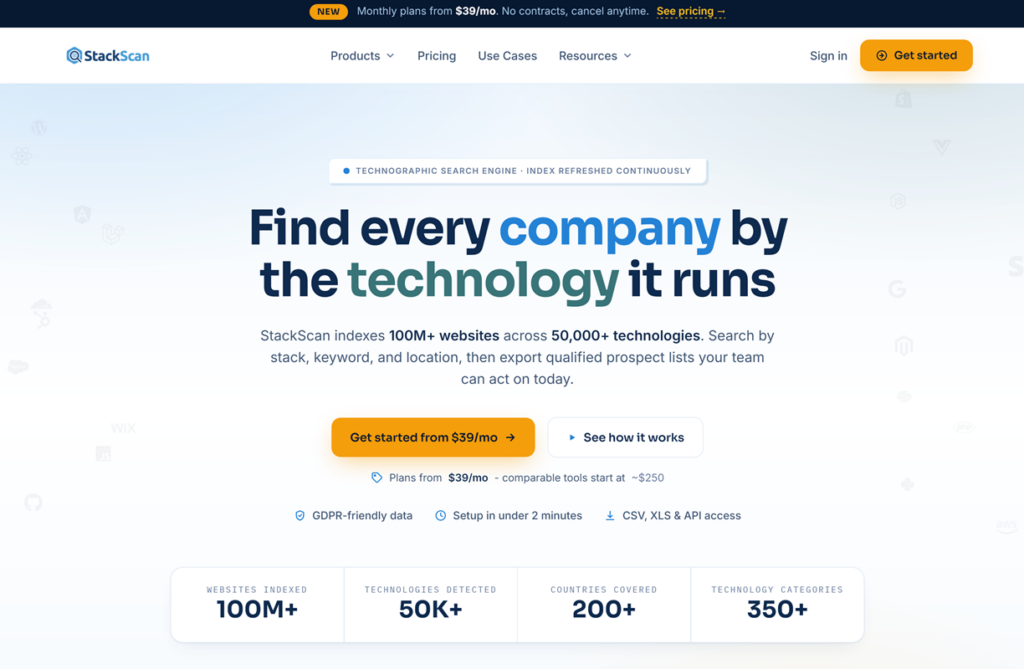
Instead of simply answering “What technology does this company use?”, StackScan makes it easy to answer questions like:

  • Which Shopify stores also use Klaviyo?
  • Which SaaS companies recently adopted OpenAI?
  • Which websites run WordPress alongside Elementor and WooCommerce?
  • Which organizations use Cloudflare but not Akamai?
  • Which companies use HubSpot without Salesforce?

Those combinations are often far more valuable than identifying a single technology in isolation.

StackScan currently tracks around 50,000 technologies across more than 100 million websites, making it practical for both individual research and large-scale prospecting.

One feature I appreciated was the ability to generate technology-based lead lists rather than manually inspecting websites one at a time.

That dramatically changes the workflow.

Instead of spending hours identifying prospects individually, sales teams can begin with a highly targeted audience based on the exact technologies they care about.

Historical technology detection is another advantage.

Technology adoption is often a buying signal.

A company that recently migrated to HubSpot, adopted Stripe, or launched on Shopify is usually undergoing operational changes, making them more receptive to complementary products.

Those signals are difficult to capture through firmographic data alone.

For technical teams, the API also opens significantly more possibilities.

Rather than exporting spreadsheets manually, technographic data can feed directly into CRMs, internal dashboards, enrichment workflows, or outbound automation systems.

Pricing is another area where StackScan stands out.

Many competing platforms reserve bulk exports, APIs, or advanced datasets for enterprise plans. StackScan offers much of that functionality at pricing that’s accessible to startups, agencies, and growing sales teams.

That makes it particularly attractive for organizations that want enterprise-grade technographic intelligence without enterprise-level pricing.

Best for:

  • B2B sales teams
  • Lead generation agencies
  • RevOps teams
  • SaaS companies
  • Market researchers
  • Anyone building technology-based prospect lists

2. BuiltWith

If StackScan is built for modern technographic prospecting, BuiltWith remains the benchmark for historical technology intelligence.

The platform has been collecting website technology data for well over a decade and has built one of the largest technology intelligence databases available. That’s why it’s still widely used by enterprise sales teams, market researchers, investment firms, and technology vendors.

Where BuiltWith shines is depth.

Instead of simply telling you that a company uses Shopify or HubSpot, it often provides historical adoption timelines, technology relationships, and detailed metadata that help explain how a company’s stack has evolved.

That historical context can be surprisingly valuable.

Imagine you’re selling a Shopify app. A merchant that migrated from Magento six months ago may still be rebuilding parts of its ecommerce stack and evaluating complementary tools. Likewise, a company that recently adopted HubSpot might also be considering integrations for customer support, analytics, or sales enablement.

BuiltWith helps uncover those kinds of transitions.

Its reporting capabilities are also among the strongest in the industry. Enterprise teams can build technology-based segments, analyze adoption trends across industries, monitor competitors, and export large datasets for internal analysis.

That said, BuiltWith shows its age in a few areas.

The interface feels geared toward analysts rather than SDRs looking to build lists quickly. New users often face a learning curve before understanding the available reports and filters. Pricing is another consideration. Many of the features that make BuiltWith attractive, including larger exports and advanced reporting, sit behind higher-tier plans that can be difficult to justify for smaller businesses.

There’s also a philosophical difference compared to newer platforms.

BuiltWith is primarily a technology intelligence platform. While sales teams use it extensively, prospecting workflows aren’t always as streamlined as tools designed specifically for outbound lead generation. You’ll often spend more time navigating reports and exporting data before reaching the same outcome.

For organizations that need extensive historical technology intelligence, however, BuiltWith remains one of the strongest options available.

What I liked

  • One of the largest historical technology databases
  • Excellent reporting and segmentation capabilities
  • Strong coverage across ecommerce, marketing, infrastructure, and analytics technologies
  • Trusted by enterprise sales, research, and investment teams
  • Reliable bulk exports for large datasets

Where it falls short

  • Premium pricing compared to many newer alternatives
  • Interface feels dated and can be overwhelming for new users
  • Better suited to analysts than day-to-day SDR workflows
  • Prospecting experience isn’t as streamlined as platforms built specifically for sales teams

BuiltWith remains an excellent choice for enterprises that prioritize historical technology intelligence and deep market analysis. If your primary goal is finding companies based on their current technology stack and turning those insights into outbound campaigns quickly, newer platforms tend to provide a more efficient workflow.

3. ZoomInfo

ZoomInfo approaches technographic data from the opposite direction of Datanyze.

Instead of starting with website technologies and expanding into sales intelligence, ZoomInfo starts with one of the largest B2B contact databases and layers technographic signals on top. For many enterprise sales organizations, that’s a compelling trade-off because contact data, organizational charts, buying intent, and technology adoption all live in the same platform.

That integration is ZoomInfo’s biggest advantage.

A typical outbound workflow might look like this:

Find companies using Snowflake, filter for organizations with 200 to 2,000 employees, identify the VP of Data Engineering and Director of Analytics, add intent signals, then push the list directly into Salesforce or a sales engagement platform.

Very few platforms can handle that entire process without additional enrichment tools.

Technographic data is only one piece of a much broader sales intelligence platform, but it’s generally strong enough for most outbound use cases. You can segment companies by CRM, marketing automation platform, cloud provider, ecommerce platform, customer support software, analytics tools, and thousands of other technologies.

Where ZoomInfo becomes especially valuable is when technology adoption is only one qualification criterion.

For example, suppose you’re selling an observability platform. You may want companies that use AWS, Kubernetes, Datadog, and Snowflake, have more than 500 employees, recently hired DevOps engineers, and show intent around cloud infrastructure. ZoomInfo allows you to combine those signals into a single prospect list.

That level of data fusion is difficult for dedicated technographic providers to match.

The downside is cost.

ZoomInfo is one of the most expensive platforms in the sales intelligence market, and pricing is rarely transparent. Smaller businesses, agencies, and startups often end up paying for a large number of features they don’t actually use.

Another consideration is focus.

If your primary objective is discovering technology adoption across millions of websites, a specialist platform often provides greater flexibility, deeper technology coverage, and better value. ZoomInfo is designed to solve the broader sales intelligence problem, with technographics serving as one component of that ecosystem.

For enterprise organizations that already rely on ZoomInfo, there’s little reason to maintain a separate technographic platform unless they require significantly deeper technology intelligence.

What I liked

  • Combines contacts, company data, intent signals, and technographics in one platform
  • Excellent filtering for complex outbound prospecting
  • Strong CRM and sales engagement integrations
  • Mature enterprise workflows and automation capabilities
  • Well suited for large sales organizations

Where it falls short

  • Premium pricing puts it out of reach for many smaller teams
  • Technographic data isn’t the platform’s primary strength
  • Can feel overwhelming if you only need technology intelligence
  • Many valuable features require higher-tier plans

If your sales team needs an all-in-one revenue intelligence platform, ZoomInfo remains one of the strongest options available. If you’re specifically investing in technographic prospecting, however, a dedicated platform like StackScan or BuiltWith often delivers more specialized technology insights at a significantly lower cost.

4. Apollo.io

Apollo.io isn’t typically mentioned in conversations about technographic data, but it probably should be.

Its primary strength is B2B contact data, yet the platform includes technology filters that make it surprisingly effective for technology-based prospecting. For many startups and SMB sales teams, that’s enough to replace a dedicated technographic tool entirely.

The biggest advantage is efficiency.

Instead of switching between a technology lookup platform and a prospect database, Apollo lets you build both parts of the workflow in one place.

For example, you can search for companies that use HubSpot, Shopify, or AWS, then immediately filter by employee count, funding stage, location, hiring activity, revenue, or job title before exporting contacts.

For SDRs, that saves a significant amount of time.

Apollo also includes sequencing, email verification, outreach automation, and CRM integrations, meaning a prospect can move from search to an active sales sequence without leaving the platform.

That said, Apollo’s technology data shouldn’t be viewed as a replacement for dedicated technographic providers.

Its technology filters cover many popular products, but they aren’t as comprehensive or granular as platforms built specifically around technology detection. If your sales strategy depends on identifying niche developer tools, infrastructure products, marketing platforms, or very specific software combinations, you’ll likely encounter limitations.

This difference becomes more apparent when building highly targeted campaigns.

Suppose you’re selling a WooCommerce plugin that integrates with Cloudflare Turnstile and Klaviyo. A dedicated technographic platform can usually identify those precise combinations. Apollo is better suited to broader filters like Shopify, Salesforce, HubSpot, or AWS.

Coverage depth also varies depending on the technology category. Enterprise software is generally well represented, while smaller SaaS products and emerging developer tools may be less consistently detected.

Pricing is another reason Apollo has become popular.

Compared to enterprise sales intelligence platforms, it offers an impressive range of functionality for the cost. Many growing sales teams find that the combination of contacts, outreach, and basic technographic filtering delivers enough value without purchasing multiple specialized tools.

What I liked

  • Combines contact data, outreach, and technology filters in one platform
  • Fast workflow from prospect discovery to outreach
  • Strong value for startups and SMB sales teams
  • Good CRM integrations and automation features
  • Transparent pricing compared to many enterprise competitors

Where it falls short

  • Technology detection isn’t as deep as dedicated technographic platforms
  • Limited coverage for niche and emerging software products
  • Fewer advanced technology search combinations
  • Historical technology adoption is limited

Apollo is an excellent choice for sales teams that prioritize speed and simplicity. If your outbound strategy relies on common technologies and you want contacts and outreach built into the same platform, it’s hard to beat. But if technology intelligence is central to your prospecting strategy, a specialist platform like StackScan provides considerably more flexibility and depth.

5. Clearbit (Now HubSpot Breeze Intelligence)

Clearbit built its reputation on company enrichment rather than technographic research.

That distinction matters because it changes how you’ll use the platform.

Instead of opening Clearbit to discover which technologies a company uses, most teams rely on it to enrich leads already flowing through their CRM, forms, product signups, or outbound workflows. Technology data is simply one attribute among hundreds of company signals.

Since its acquisition by HubSpot, many of Clearbit’s capabilities have been integrated into HubSpot Breeze Intelligence, making it an even more attractive option for organizations already invested in the HubSpot ecosystem.

This is where Clearbit excels.

Imagine someone signs up for a product demo using their work email. Within seconds, the platform can enrich that record with company information such as industry, employee count, revenue estimates, location, and technology usage. That enriched profile can then trigger routing rules, lead scoring, or personalized outreach automatically.

For RevOps teams, that automation often delivers more value than manually researching prospects.

Technology data becomes one signal in a larger qualification model.

For example, a lead using Salesforce, Segment, and Snowflake might be routed directly to an enterprise account executive, while another using WordPress and Mailchimp follows a different sales path.

Where Clearbit is less compelling is standalone technographic prospecting.

You won’t find the same level of technology-first workflows offered by dedicated providers. Building large lists of companies based on precise technology combinations isn’t the platform’s primary purpose, and organizations that depend heavily on technology segmentation will usually pair HubSpot with a specialist technographic data provider.

Another consideration is ecosystem dependence.

The closer your business is to HubSpot, the more valuable Breeze Intelligence becomes. If your CRM lives elsewhere, some of its biggest advantages become less relevant.

That’s not necessarily a drawback, but it’s an important trade-off when comparing platforms.

What I liked

  • Excellent company enrichment for inbound and outbound workflows
  • Strong API and automation capabilities
  • Deep integration with HubSpot CRM
  • Technology data works well alongside hundreds of other enrichment attributes
  • Ideal for lead scoring and routing

Where it falls short

  • Not designed for large-scale technographic prospecting
  • Limited technology-first search and segmentation compared to dedicated platforms
  • Most valuable for teams already using HubSpot
  • Less suitable if technology intelligence is your primary buying criterion

If your goal is enriching CRM records and automating sales workflows, Clearbit remains one of the strongest options available, particularly within the HubSpot ecosystem. But if you’re actively searching for companies based on their technology stack, platforms like StackScan or BuiltWith offer a much more focused and capable experience.

6. Cognism

Cognism is best known for its B2B contact database, particularly among companies selling into Europe.

While many sales intelligence platforms compete on the size of their contact database, Cognism has built much of its reputation around data quality, compliance, and international coverage. That makes it a common alternative for teams that find US-centric platforms less effective when prospecting across EMEA.

Technographic data is available, but it isn’t the platform’s defining feature.

Instead, Cognism treats technology adoption as another qualification layer alongside firmographics, buyer intent, hiring signals, and verified contact information.

For example, a cybersecurity vendor targeting financial institutions could search for companies using Microsoft Azure, operating in regulated industries, with more than 500 employees, then identify CISOs and IT directors within those accounts.

That workflow is where Cognism performs well.

It combines enough technology intelligence to narrow your target market while keeping the focus on finding verified decision-makers.

One area where Cognism consistently receives positive feedback is contact verification.

For outbound teams, accurate phone numbers and email addresses often have a greater impact on campaign performance than marginal differences in technographic coverage. If your priority is booking meetings rather than conducting technology research, that’s a meaningful advantage.

The trade-off is flexibility.

Dedicated technographic platforms allow you to build highly specific technology-based segments, explore niche software adoption, and analyze technology relationships in much greater detail. Cognism is designed to help sales teams reach the right people, not necessarily become experts in a company’s technology stack.

Pricing also places it firmly in the enterprise category.

Smaller teams looking primarily for technology intelligence may find that they’re paying for a much broader sales platform than they actually need.

What I liked

  • Excellent coverage for European and international markets
  • Strong reputation for verified contact data
  • Technology filters integrate well with broader prospecting criteria
  • Good CRM and sales engagement integrations
  • Well suited for enterprise outbound teams

Where it falls short

  • Technographic data isn’t as deep as specialist providers
  • Enterprise pricing may be difficult for startups and SMBs
  • Better for contact discovery than technology research
  • Limited flexibility for advanced technology-based segmentation

Cognism is a strong choice if your sales strategy revolves around verified contacts, especially across EMEA. If your competitive advantage comes from identifying companies based on highly specific technology stacks or adoption patterns, a dedicated technographic platform will provide considerably more depth.

7. LeadIQ

At first glance, LeadIQ and Datanyze look similar. Both are popular Chrome extensions used by SDRs during prospecting.

In practice, they solve different problems.

Datanyze helps answer “What technology does this company use?” LeadIQ focuses on “Who should I contact at this company?”

That difference becomes obvious after a few hours of use.

With Datanyze, I spent more time qualifying accounts based on their technology stack. With LeadIQ, I spent more time collecting verified contacts from LinkedIn and pushing them into Salesforce or Outreach.

If your outbound strategy starts with technology adoption, for example companies using HubSpot, Shopify, or Snowflake, Datanyze gives you a stronger starting point.

If your ICP is already defined and you simply need decision-maker emails as quickly as possible, LeadIQ is the faster workflow.

Where LeadIQ falls behind Datanyze is the depth of its technology intelligence. Technology filters exist, but they aren’t detailed enough for advanced technographic prospecting or market research.

Choose LeadIQ if:

  • Your biggest bottleneck is finding contacts
  • SDR productivity matters more than technology research
  • Most prospecting happens through LinkedIn

Stick with Datanyze if:

  • Technology adoption drives account selection
  • You regularly qualify companies by software stack
  • Technographics are part of your ICP

8. Lusha

Lusha has become one of the most popular prospecting tools for small and mid-sized sales teams because it focuses on a simple promise: find accurate contact information quickly.

Like Apollo and LeadIQ, it isn’t a technographic platform first. Technology filters are available, but they’re designed to help narrow prospect lists rather than provide deep insights into a company’s software stack.

That’s an important distinction when comparing it with Datanyze.

If your workflow starts with, “I need the email address of the Head of Marketing at this company,” Lusha performs very well.

If it starts with, “Show me every ecommerce company using Klaviyo, Recharge, Gorgias, and Shopify Plus,” you’ll likely want a dedicated technographic provider instead.

Where Lusha excels is usability.

The interface is clean, prospect searches are straightforward, and the Chrome extension makes it easy to capture contacts while browsing LinkedIn or company websites. New sales reps can usually become productive within a few hours without extensive training.

For startups and SMBs, that simplicity is often more valuable than having dozens of advanced filters they’ll rarely use.

Another strength is data enrichment.

Lusha integrates with popular CRMs and sales engagement platforms, allowing teams to enrich company and contact records without adding significant complexity to their workflow.

The platform is particularly useful for organizations that already know their target accounts and simply need reliable decision-maker information to begin outreach.

Where it falls behind Datanyze alternatives focused on technographics is technology intelligence itself.

Technology coverage is relatively broad for common business software, but it lacks the depth needed for advanced segmentation. Historical technology adoption, niche SaaS detection, and detailed technology relationships are not major areas of focus.

As your outbound strategy becomes more sophisticated, those limitations become more noticeable.

What I liked

  • Simple, intuitive interface
  • Fast contact discovery with a solid Chrome extension
  • Good CRM integrations and enrichment capabilities
  • Easy for smaller sales teams to adopt
  • Transparent workflow with minimal learning curve

Where it falls short

  • Technology data is secondary to contact discovery
  • Limited advanced technographic filtering
  • Not designed for technology market research
  • Less effective for building highly targeted technology-based prospect lists

Lusha is an excellent prospecting tool when your priority is reaching the right people quickly. However, if your competitive advantage depends on identifying companies based on detailed technology adoption, specialist platforms like StackScan or BuiltWith provide significantly deeper insights and more flexible segmentation capabilities.

9. Slintel (Now Part of 6sense)

If you’ve been using Datanyze for a while, there’s a good chance you’ve come across Slintel before.

Before being acquired by 6sense, Slintel built a strong reputation around technographic data and intent-based prospecting. It was one of the few platforms that felt like a direct competitor to Datanyze rather than a general sales intelligence database.

Today, Slintel’s capabilities live inside the broader 6sense platform.

That changes the experience considerably.

Datanyze is relatively straightforward. You identify companies using certain technologies, find contacts, and start prospecting.

6sense is designed for a much larger revenue operation.

Instead of simply filtering companies by technologies, it combines technographics with buying intent, predictive analytics, account engagement, CRM data, and AI-driven recommendations. For enterprise organizations running account-based marketing programs, that additional context can be extremely valuable.

For example, imagine two companies both use Salesforce and Snowflake.

Datanyze would likely identify both as qualified prospects.

6sense goes a step further by estimating which company is actively researching products in your category, showing stronger buying signals and a higher likelihood of entering a sales cycle.

That’s information Datanyze was never intended to provide.

The trade-off is complexity.

What was once a relatively focused technographic platform has become part of an enterprise revenue platform with a much steeper learning curve. Smaller sales teams looking for a simple replacement may find themselves paying for predictive models, ABM features, and orchestration capabilities they’ll rarely use.

If your primary need is identifying companies based on their technology stack, Datanyze remains simpler and easier to adopt.

If you’re running enterprise account-based sales programs where technographics are just one input among dozens of buying signals, 6sense becomes much more compelling.

What I liked

  • Strong combination of technographics and buying intent
  • Excellent fit for enterprise ABM strategies
  • Predictive account scoring adds valuable context
  • Deep CRM and marketing automation integrations
  • More strategic than standalone technology lookup tools

Where it falls short

  • Considerably more complex than Datanyze
  • Enterprise-focused pricing
  • Overkill for smaller sales teams
  • Technology research is now part of a much larger platform rather than the primary focus

If you liked what Slintel originally offered but your organization has grown into enterprise account-based selling, 6sense is a logical evolution. For teams simply looking to replace Datanyze’s technographic capabilities, however, the additional complexity may outweigh the benefits.

10. Similarweb

At first glance, Similarweb doesn’t seem like a Datanyze alternative at all.

It’s primarily known for website traffic estimates, audience insights, referral sources, keyword research, and market intelligence. Yet I found myself using it alongside technographic tools more often than expected because it answers a different, but equally important, question.

Datanyze tells you what technologies a company uses.

Similarweb helps explain how significant that company is.

For example, suppose you identify 2,000 Shopify stores with Datanyze. Without additional context, every company looks equally valuable.

Open those same companies in Similarweb, and you’ll quickly see major differences in estimated traffic, geographic markets, audience growth, acquisition channels, and competitive positioning.

That context helps prioritize outreach.

A sales team targeting enterprise ecommerce brands may focus on high-traffic retailers investing heavily in paid acquisition. A startup selling an affordable Shopify app might instead prioritize fast-growing stores with modest traffic and lean technology stacks.

Datanyze doesn’t attempt to solve that prioritization problem, and it isn’t supposed to.

Similarweb also offers some technology information, but it shouldn’t be considered a replacement for dedicated technographic platforms. The technology coverage is much narrower, and most users subscribe because they need competitive intelligence rather than software stack analysis.

The biggest value comes from combining the two platforms.

Use Datanyze or another technographic provider to identify companies based on technology adoption, then use Similarweb to determine which of those companies deserve your attention first.

What I liked

  • Excellent website traffic and market intelligence
  • Strong competitive analysis tools
  • Helpful for prioritizing technology-qualified accounts
  • Useful audience and acquisition insights
  • Great for market research and competitive benchmarking

Where it falls short

  • Not a dedicated technographic platform
  • Limited technology detection compared to Datanyze
  • Prospecting features are secondary to market intelligence
  • Premium plans can become expensive

If you’re replacing Datanyze because you need deeper technology intelligence, Similarweb isn’t the answer. But if you’re looking for better context around the companies you’ve already identified, it’s one of the most valuable complementary tools you can add to your workflow.

11. HG Insights

HG Insights is probably the closest thing to an enterprise-grade replacement for Datanyze.

Both platforms use technographic data to help sales teams identify better prospects, but they’re built for very different audiences.

Datanyze is designed to help individual sales reps and smaller teams qualify accounts quickly.

HG Insights is built for large organizations that want technographic data embedded across territory planning, account scoring, TAM analysis, and revenue operations.

That difference becomes clear the moment you start using the platform.

Rather than searching for companies using a particular technology, HG Insights encourages you to analyze entire markets.

For example, a cybersecurity vendor might identify every enterprise running VMware alongside Palo Alto Networks, then prioritize accounts based on IT spend, cloud maturity, infrastructure investments, and technology refresh cycles.

It’s less about finding your next prospect and more about understanding where your biggest opportunities exist.

Another strength is the depth of enterprise technology coverage.

HG Insights has invested heavily in detecting infrastructure software, cloud platforms, networking products, enterprise applications, and hardware environments. If you’re selling into Fortune 1000 companies, those signals can be considerably more valuable than knowing whether a business uses a particular marketing automation platform.

That said, most SMB sales teams won’t need this level of sophistication.

The platform is built for organizations with dedicated RevOps teams, complex sales motions, and enterprise budgets. If you’re replacing Datanyze because you need a simple way to identify technology-qualified prospects, HG Insights will likely feel like far more platform than you actually require.

Pricing reflects that positioning as well.

Unlike Datanyze, which is accessible to smaller businesses, HG Insights primarily serves enterprise customers and is typically purchased through custom sales engagements.

What I liked

  • Excellent enterprise technographic coverage
  • Strong insights into infrastructure and IT environments
  • Well suited for territory planning and market analysis
  • Rich data for enterprise account prioritization
  • Designed for large RevOps and sales organizations

Where it falls short

  • Enterprise pricing
  • Significant learning curve
  • More platform than most SMBs need
  • Not ideal for quick day-to-day prospecting

If you’re an enterprise sales organization looking to make technographics a core part of your go-to-market strategy, HG Insights deserves serious consideration. For startups, agencies, and growing sales teams simply looking for a modern Datanyze replacement, it’s likely more complex and expensive than necessary.

12. Wappalyzer

Wappalyzer is probably the tool most people have installed without thinking of it as a Datanyze alternative.

Unlike Datanyze, which combines technographic data with sales prospecting features, Wappalyzer focuses almost entirely on identifying the technologies behind a website. Install the browser extension, visit a website, and you’ll instantly see the CMS, analytics tools, JavaScript frameworks, hosting provider, ecommerce platform, advertising technologies, and much more.

For individual website research, it’s hard to beat.

The extension is fast, accurate, and requires almost no learning curve. Whether you’re a developer investigating a competitor’s stack or a salesperson qualifying a prospect before a meeting, it delivers the information you need within seconds.

Where the comparison with Datanyze starts to break down is scale.

Datanyze is designed to help you find companies based on technology adoption. Wappalyzer helps you inspect websites you already know about.

That’s a subtle but important distinction.

Suppose you’re selling a Shopify analytics platform.

With Datanyze, you can search for Shopify merchants that match your ideal customer profile and begin building a prospect list.

With Wappalyzer, you would typically visit each company’s website individually to verify its technology stack.

That manual workflow is perfectly reasonable for researching a handful of accounts, but it doesn’t scale well when you’re qualifying hundreds or thousands of companies.

Wappalyzer also offers APIs and paid plans, but its primary audience remains developers, marketers, consultants, and researchers rather than outbound sales teams building technology-driven prospect lists.

What I liked

  • One of the best browser extensions for technology detection
  • Fast and accurate website analysis
  • Excellent coverage of common web technologies
  • Very easy to use
  • Great for one-off research and competitor analysis

Where it falls short

  • Built around individual website inspection rather than prospecting
  • Limited lead generation capabilities compared to Datanyze
  • Less suitable for bulk technology-based searches
  • Sales workflows require additional tools

If your daily work involves inspecting individual websites, Wappalyzer remains one of the best tools available. But if you’re replacing Datanyze because you want to build outbound lists based on technology adoption, you’ll quickly outgrow a browser extension and benefit from a platform designed for large-scale technographic prospecting.

Which Datanyze Alternative Should You Choose?

After spending time with each platform, one thing became clear: there isn’t a single replacement that’s best for everyone.

The right choice depends on why you’re moving away from Datanyze in the first place.

If your biggest frustration is limited technology coverage or the inability to build highly targeted prospect lists, you’ll get the most value from a dedicated technographic platform.

If you’re looking for an all-in-one sales intelligence solution with contacts, outreach, and CRM integrations, a broader sales platform may make more sense even if its technographic data isn’t as detailed.

Here’s how I’d choose.

Choose StackScan if…

You’re buying a technographic platform first.

StackScan is the strongest option if your workflow revolves around finding companies based on technology adoption, generating targeted lead lists, tracking technology changes, or integrating technographic data into your own systems through an API.

It’s particularly well suited for sales teams, agencies, SaaS companies, and RevOps teams that want deep technology intelligence without enterprise-level pricing.

Choose BuiltWith if…

Historical technology data is your priority.

BuiltWith remains one of the best tools for researching how a company’s technology stack has evolved over time and analyzing adoption trends across large markets.

It’s especially valuable for enterprise research, competitive intelligence, and investment analysis.

Choose ZoomInfo if…

You want a complete sales intelligence platform.

Technographics are only one part of a much broader database that includes verified contacts, buying intent, company insights, and workflow automation.

The trade-off is significantly higher pricing.

Choose Apollo if…

You want to combine prospecting and outreach in one platform.

Apollo offers enough technology filtering for many outbound teams while also providing contacts, email sequencing, and CRM integrations at a price that’s accessible for startups and growing businesses.

Choose Wappalyzer if…

Most of your work involves researching individual websites.

It’s still one of the fastest and easiest ways to identify a website’s technology stack, even though it isn’t designed for large-scale prospecting.

Choose HG Insights or 6sense if…

You’re part of a large enterprise running sophisticated account-based marketing or revenue operations programs.

Both platforms extend far beyond traditional technographic data and are built for organizations with dedicated RevOps teams and enterprise budgets.

Final Thoughts

Datanyze deserves credit for helping establish technographic data as a practical sales signal.

But the market has evolved.

Today’s buyers expect more than a browser extension and basic technology filters. They want richer technology coverage, fresher data, bulk prospecting, APIs, CRM integrations, and workflows that scale from a few prospects to millions of companies.

That’s why so many newer platforms have moved beyond simply identifying website technologies.

If your goal is researching a handful of companies before a sales call, Datanyze still does a solid job.

If your goal is building repeatable outbound campaigns around technology adoption, modern technographic platforms offer significantly more flexibility.

For most teams, StackScan stands out as the best overall Datanyze alternative because it stays focused on what made Datanyze valuable in the first place: using technology data to find better prospects. It then builds on that foundation with broader technology coverage, bulk lead generation, historical insights, APIs, and pricing that’s practical for startups as well as growing sales organizations.

Ultimately, the best platform is the one that fits your workflow. Evaluate a few, test them against your own ideal customer profile, and choose the tool that helps your team spend less time researching and more time talking to qualified prospects.

Put Your Software in Front of Buyers

Get listed on eBool — one-time pricing, permanent visibility, and exposure across one of the web's largest software directories.

Get Listed