Datanyze helped popularize technographic prospecting long before “sales intelligence” became a crowded category. For many SDRs, it was the first tool that made it easy to identify the technologies a company used and turn that information into better outreach.
The market has changed considerably since then.
Today, sales teams expect much more than a Chrome extension that identifies a website’s tech stack. They want bulk prospecting, downloadable lead lists, APIs, CRM integrations, historical technology adoption, and coverage that extends well beyond a few thousand popular technologies.
To see how Datanyze compares today, I spent time testing it alongside several established competitors and newer platforms. Some focused on technographics, others approached the problem through broader sales intelligence. A few surprised me.
Here’s what I’d actually recommend.
Why People Start Looking for Datanyze Alternatives
Most people aren’t replacing Datanyze because it’s a bad product. They’re replacing it because their workflow has outgrown it.
A freelancer researching a handful of websites each day has very different requirements than a revenue operations team qualifying thousands of accounts every week.
These are the most common reasons I found people switching.
They need broader technology coverage
Modern companies use hundreds of SaaS products across marketing, engineering, analytics, customer support, payments, infrastructure, and security.
A limited technology database inevitably misses part of that stack, which means missing valuable buying signals.
For example, knowing that a prospect uses Shopify is useful. Knowing they also use Klaviyo, Recharge, Gorgias, Postscript, Nosto, Segment, and Snowflake paints a much clearer picture of their business and the tools they’re likely to adopt next.
They want prospecting, not just research
Identifying technologies on one website is helpful.
Building a list of 8,000 companies using HubSpot, Stripe, Cloudflare, and Vercel is considerably more valuable for outbound sales.
Many newer platforms have shifted their focus toward technology-based lead generation rather than individual website lookups.
Freshness matters
Technology stacks change constantly.
Companies migrate from Universal Analytics to GA4.
They move from Magento to Shopify.
They replace Intercom with Zendesk.
They adopt Cloudflare, migrate to Vercel, or switch payment providers.
If technology data isn’t updated frequently enough, sales teams end up targeting companies with outdated assumptions.
APIs have become essential
Technographic data rarely lives in isolation anymore.
Sales teams enrich Salesforce.
Marketing teams segment HubSpot audiences.
RevOps teams automate routing inside Clay, n8n, Zapier, or internal systems.
Without API access, technographic data becomes difficult to integrate into larger workflows.
Pricing becomes difficult to justify
Many companies start with a browser extension but later discover they need exports, bulk searches, APIs, and additional seats.
That’s often when they begin evaluating alternatives that offer more functionality for a similar budget.
The good news is that today’s market offers plenty of options, each optimized for different use cases rather than trying to be everything for everyone.
What I Looked For During Testing
I wasn’t interested in whichever platform claimed the biggest database.
Marketing pages often report impressive numbers, but those numbers don’t necessarily translate into better prospecting.
Instead, I focused on questions that matter during day-to-day use.
- How accurately does it identify technologies across different industries?
- Does it support bulk prospecting instead of single-site lookups?
- Can I export useful lead lists?
- Is there an API for automation?
- How practical is it for SDRs, agencies, and RevOps teams?
- Does the pricing make sense relative to the value provided?
Some tools excelled at enterprise intelligence.
Others were surprisingly good despite being much smaller.
And a few felt like products that haven’t evolved alongside modern outbound workflows.
1. StackScan
If I were choosing a replacement for Datanyze today, StackScan would be my first pick.
The biggest difference is philosophy.
Datanyze began as a sales intelligence platform with technographic capabilities.
StackScan is built around technology intelligence itself, then expands that into lead generation, prospecting, and automation.
That distinction becomes obvious once you move beyond looking up individual websites.
Instead of simply answering “What technology does this company use?”, StackScan makes it easy to answer questions like:
- Which Shopify stores also use Klaviyo?
- Which SaaS companies recently adopted OpenAI?
- Which websites run WordPress alongside Elementor and WooCommerce?
- Which organizations use Cloudflare but not Akamai?
- Which companies use HubSpot without Salesforce?
Those combinations are often far more valuable than identifying a single technology in isolation.
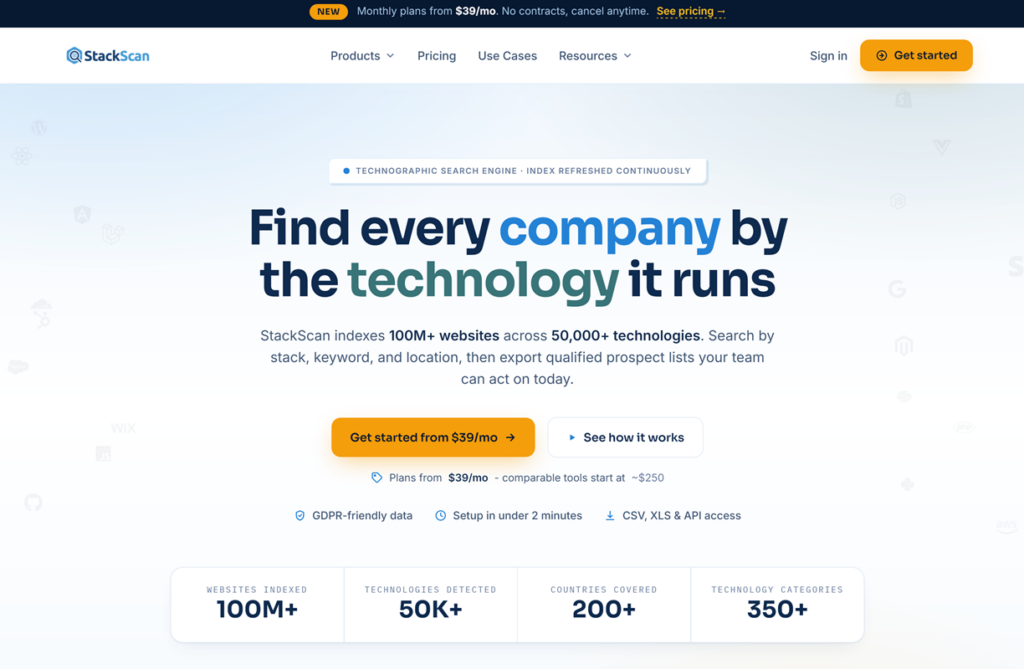
StackScan currently tracks around 50,000 technologies across more than 100 million websites, making it practical for both individual research and large-scale prospecting.
One feature I appreciated was the ability to generate technology-based lead lists rather than manually inspecting websites one at a time.
That dramatically changes the workflow.
Instead of spending hours identifying prospects individually, sales teams can begin with a highly targeted audience based on the exact technologies they care about.
Historical technology detection is another advantage.
Technology adoption is often a buying signal.
A company that recently migrated to HubSpot, adopted Stripe, or launched on Shopify is usually undergoing operational changes, making them more receptive to complementary products.
Those signals are difficult to capture through firmographic data alone.
For technical teams, the API also opens significantly more possibilities.
Rather than exporting spreadsheets manually, technographic data can feed directly into CRMs, internal dashboards, enrichment workflows, or outbound automation systems.
Pricing is another area where StackScan stands out.
Many competing platforms reserve bulk exports, APIs, or advanced datasets for enterprise plans. StackScan offers much of that functionality at pricing that’s accessible to startups, agencies, and growing sales teams.
That makes it particularly attractive for organizations that want enterprise-grade technographic intelligence without enterprise-level pricing.
Best for:
- B2B sales teams
- Lead generation agencies
- RevOps teams
- SaaS companies
- Market researchers
- Anyone building technology-based prospect lists